
Security deposit: when it is authorized, captured, and released
When the security deposit is authorized on the card, how you capture it, partially or fully release it, and how automatic release works.
Updated on November 12, 2026
The security deposit is never charged directly, but reserved (authorized) on the guest's card. You can only capture it as long as this hold is active. You set the amount and portals under Open Deposit & Protection, see "Deposit & Protection: the protection modes at a glance".
This article applies to the card security deposit from the online check-in (card "Damage Protection / Deposit" on the booking). A fixed deposit transferred by the guest, for example for long stays or companies, runs via the card "Security deposit (bank transfer)": see "Security deposit via bank transfer: request, receive, settle".
The process
- Online check-in: The guest enters their card details. The booking then shows "Card on file" and the date under "Authorization on".
- One day before departure, Xentra authorizes the amount on the card. Status: "Authorized".
- After departure, you decide: capture, partially capture, or release. If you do nothing, the security deposit is automatically released.
Why so late: A card hold only lasts around 7 days with Stripe, after which the bank releases the money automatically. A hold placed on the arrival date for a longer stay would have expired long before you need it. This way, the security deposit can be captured until at least 3 days after check-out.
Capture or release security deposit
Open the booking. In the "Damage Protection / Deposit" card, you see the amount, status, "Can be captured until", and "Auto-release". Below that:
- "Captured": the full amount is charged. You can enter a reason.
- "Share": you only capture a partial amount ("Capture partial amount"), the rest goes back to the guest.
- "Release": the guest gets the hold back immediately.
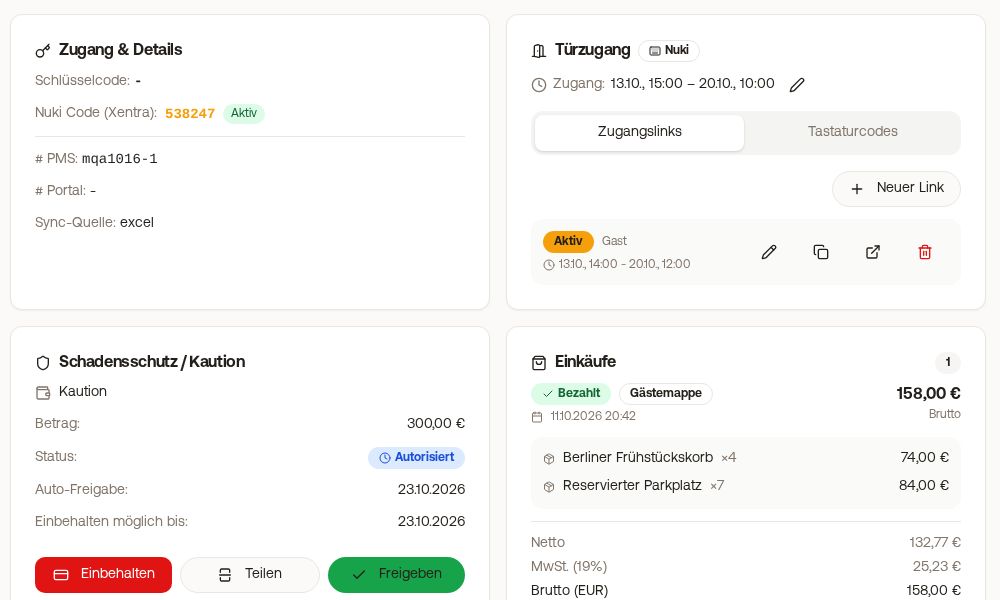 Security deposit in the booking with the buttons Captured, Share, and Release
If the date under "Can be captured until" has passed, it shows "Hold expired": the money is already back with the guest and can no longer be captured. 48 hours before expiration, you receive a notification in the bell icon so you can decide in time.
If the card could not be charged one day before departure (for example because the bank requests confirmation from the guest), it shows "Authorization failed". Resolve the deposit directly with the guest in that case.
When the security deposit is automatically released
The release runs once per night, you do not need to trigger anything. You set how fast yourself: Open Deposit & Protection, Global defaults tab, "Deposit release" card, "Release at the latest" field: from 1 day to 7 days after departure. The setting applies to all properties and only appears in modes with a deposit.
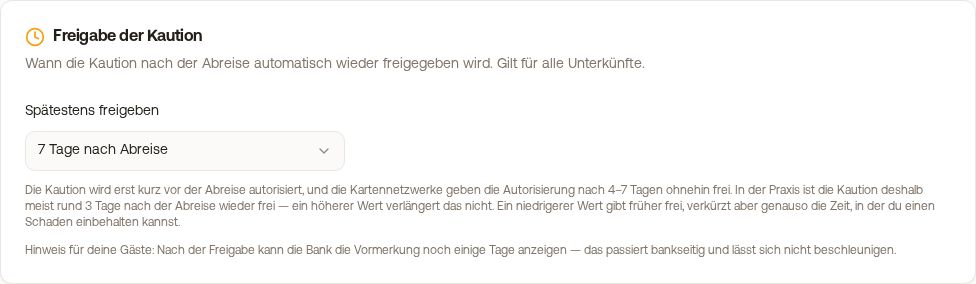 Deposit release card with the field Release at the latest
A higher value does not extend the deadline beyond the Stripe window: in practice, the security deposit is usually released again around 3 days after departure. A lower value releases earlier, but equally shortens the time in which you can capture damage.
What it costs
There are no fees for a security deposit that is released. Xentra retains the platform fee on the captured amount (net plus VAT; you can find the current rate on the pricing page), unless agreed otherwise for your account. You can see all deposits with status and fee under Open Billing in the "Deposits" tab.
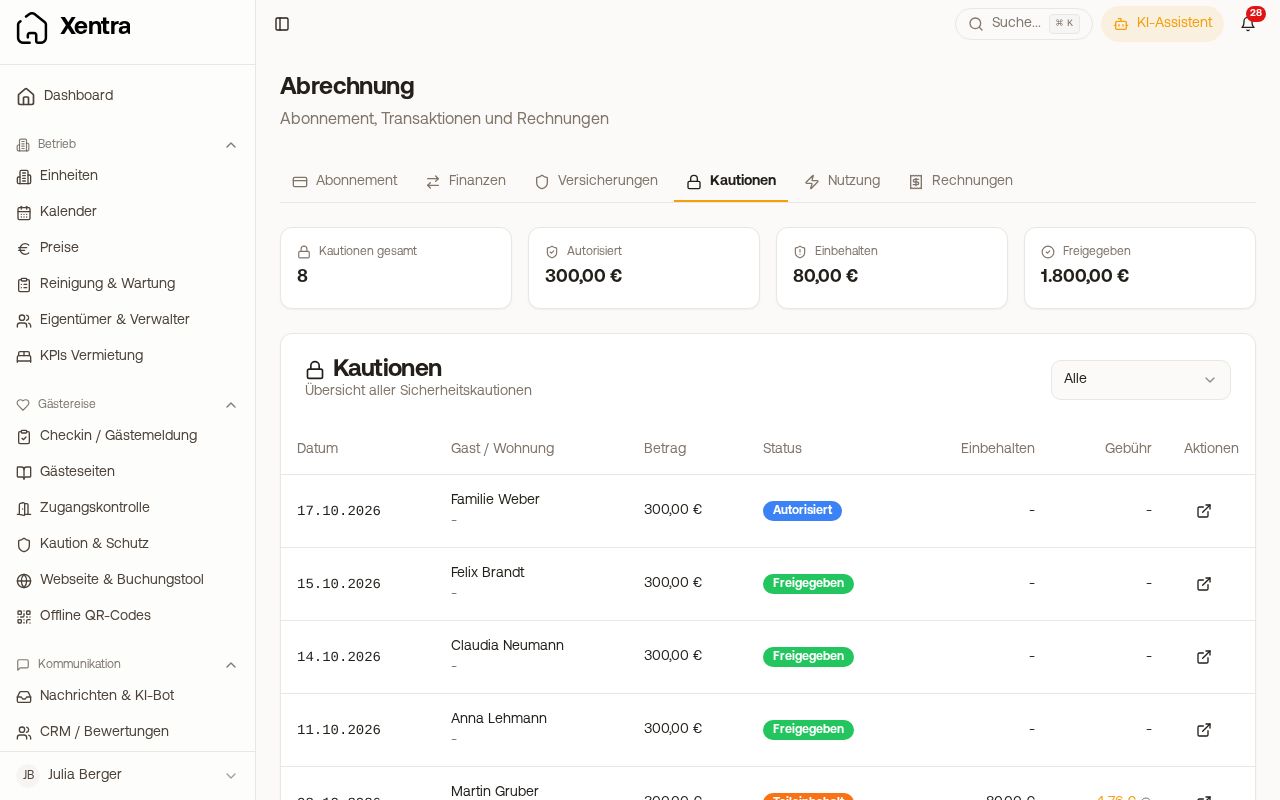 Billing, Deposits tab with authorized, released, and partially captured deposits
If you remove the security deposit from a property, an already deposited security deposit can no longer be captured afterward.
Why guests ask anyway
On a bank statement, a hold looks like a charge to many guests. After the release, the bank may still show the pending charge for a few days; this happens at the bank and cannot be sped up. A sentence about this in your arrival message clears up most questions in advance.